

The money is spent. The person still cannot get to it.
You pay for a health plan every month. It is one of the largest things on your books. And somewhere in your company this week, someone put off a doctor visit because they did not know what it would cost them.
Both of those things are true at once. That is the problem worth looking at this year.

When one person is confused, ask what happened. When most are, look at the test.
Uche Enemchukwu put it in a way that is hard to argue with. When one student fails, you ask what happened to the student. When most of the class fails, you examine the system.
Benefits is the one place we still refuse to do that. Someone cannot work out what is covered, so we call it a knowledge gap. Someone misses a deadline, so we call it personal responsibility. As she writes, we ask people to meet us where we are, instead of meeting them where they are.
Meanwhile the amount we ask of them keeps growing. Higher premiums. Higher out of pocket costs. More decisions to make alone. All of it arriving while people are also dealing with the cost of housing, fuel and groceries, and while trust in institutions generally is falling.
Benefits are often called simple, not rocket science. Yet even highly trained people get lost in them. Somewhere between those experts and a child translating a benefits letter for a parent sits every person you employ.
Source: BenefitsPRO, "Why failing benefits systems need a complete redesign"
They are insured. They still cannot cover the first few thousand dollars.
The most uncomfortable finding here comes from a national survey of employees.
About 31% of employees who have no supplemental coverage say they would pay the whole cost of it themselves.
Read that again. Nearly a third are not asking their employer to fund anything. They are asking to be offered it, and they will cover it out of their own pay.
Diana Steinhoff describes the situation plainly. Employees are technically insured but functionally unable to afford care. Deductibles and out of pocket maximums have climbed far faster than wages, and many families do not have savings to absorb a single unplanned bill.
The old extras were built for rare events. A specific accident. A short list of critical illnesses. A hospital stay. But the bills that actually hurt a family are ordinary ones, like an urgent care visit for a child, which still runs into thousands of dollars before the deductible is met. So the cover almost never paid out, and people stopped believing it was worth having.
Newer designs pay on the diagnosis instead, with some recognizing more than 13,000 conditions and paying automatically off the medical claim rather than a form filled in during a crisis.
Source: BenefitsPRO, "Why supplemental health isn't 'supplemental' anymore", national survey on voluntary benefits
Four places the system loses people
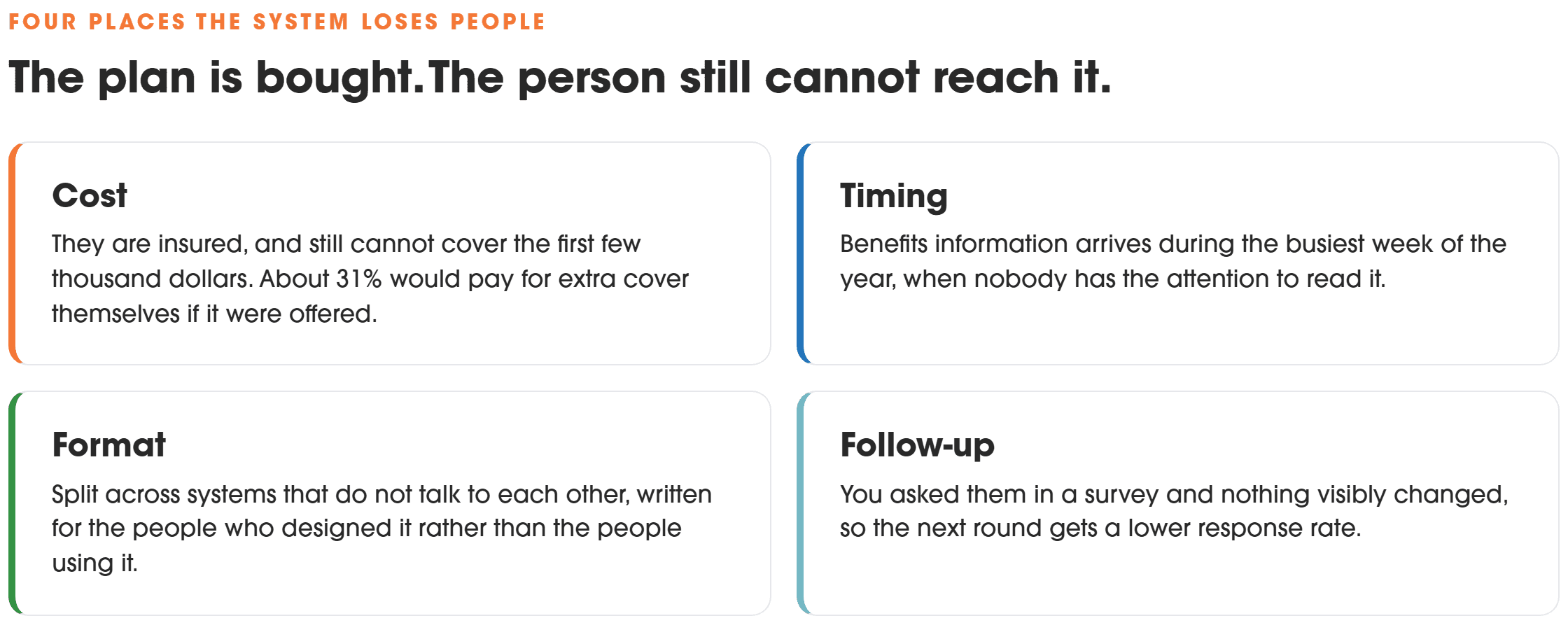
You asked them. Then nothing happened.
Most people have filled in a survey at work that went nowhere. You can usually tell, because the next one gets a lower response rate.
Liz Reimer, who was chief human resources officer at Premise Health, makes the case that an engagement survey should work as a trust check rather than a compliance task. Tie the questions to the values you actually claim, and the answers show you whether the culture you describe is the culture people experience.
Ask whether someone feels comfortable speaking openly with their leader. Ask whether they believe in where the company is going. Those questions give you a real reading, she writes, but only if you are willing to read them with an open mind and act on what they reveal.
That last clause is where most companies stop. And it is the only part your team remembers. Asking and then doing nothing costs more trust than never asking at all.
Source: BenefitsPRO, "How to turn employee engagement survey data into organizational trust"
You cannot fix what you cannot see
There is a structural reason so many employers are flying blind, and it sits in the funding model.
Mehul Agarwal argues that the choice between fully insured, level funded and self funded is not really an accounting decision. It determines what an employer can see, what it can control, and how quickly it can respond when costs move.
Fully insured hands the claims risk, and most of the underlying data, to the carrier. So at renewal you receive a number without a reason. Self funded flips that: you pay claims as they come, usually with stop loss coverage capping catastrophic exposure, and in return you get direct access to claims experience and far more control over plan design. Level funding sits between the two, a steady monthly amount bundling expected claims, stop loss and administration, with the possibility of money back if claims run below projection.
The decision usually gets made on one number, which is headcount. Agarwal's point is that size alone is an incomplete measure of risk. Two employers who clear the same size threshold can carry very different risk depending on claims history, who is on the plan, how much long term illness sits in the group, and whether a small number of very large claims is driving most of the spend.
Without that deeper view, he writes, the decision defaults to caution or to whatever the incumbent carrier proposes. A group that looks risky on paper may be a strong self funding candidate once you understand its spend. A group that looks safe may be carrying concentrated risk that level funding will eventually expose at renewal.
Source: BenefitsPRO, "Level-funded vs. self-funded: Why data beats group size"
And the bill for all of this is expected to keep climbing
None of the above gets easier next year.
Zywave's midyear outlook projects health care costs rising about 6.5% in 2026 on average, with some estimates running past 10%. Their broker survey found that balancing an attractive benefits package against rising costs is employers' single biggest concern.
The outlook also flags something that belongs in this argument. Artificial intelligence has moved out of pilot projects and into routine benefits administration. And a trust gap is widening between how interested employers are in these tools and how willing employees are to use them.
Which brings us to the last piece, and the reason the fix is not the one most people reach for.
Source: BenefitsPRO, "Health care costs, AI adoption drive employee benefits strategy", Zywave, Employee Benefits Midyear Market Outlook
Your benefits help desk is a person, not a portal

Resume Now surveyed 1,006 employed adults in the United States this June. About 97% said they rely on their own judgment or input from coworkers and managers before turning to AI tools. Roughly 74% trust their own judgment first, and another 23% go to a colleague.
When decisions are high stakes and time sensitive, the pattern sharpens. About 60% rely on their own judgment and 33% on colleagues, leaving just 7% who would lean on AI in those moments. Given a straight choice, around 72% would follow a coworker's judgment over the AI output.
Keith Spencer of Resume Now summed it up: AI is becoming part of how work gets done, but workers do not want it to have the final say.
Now apply that to benefits. Every question your team has about coverage is a high stakes, time sensitive decision to the person asking it. Which means it walks to a human being. In a company of 20 to 99 people, that human being is usually the owner, the office manager, or whoever has been kind enough to answer before.
That person already has a full time job. The cost of them stopping to answer never appears on an invoice, which is exactly why it never gets managed.
Source: BenefitsPRO, "AI isn't replacing human decision-making at work just yet", Resume Now
What to actually do about it
You do not need a consultant to start. You need an afternoon and a willingness to look.
Find out what your deductible is, then ask honestly whether most of your team could pay it this month.
Check how many people took up the extras you already offer. Low take-up is a signal, not a preference.
For one week, write down every benefits question you get asked, who asked it, and how long it took to answer. Add up the minutes on Friday.
Ask one person what happened the last time they tried to use the plan. The answer comes fast and it is specific.
Before your next renewal, ask to see a number other than the quote. If nobody can produce one, that is the finding.
None of that changes your plan. It tells you whether your plan is reaching the people you bought it for. Which is the question underneath all of this. It is the one almost nobody is asking.
Let’s Talk
See what it’s like to have the benefits department you don’t have to build.
A 20-minute Zoom. No pressure, no obligation.


