

It is not one thing getting harder. It is five.
Employer benefits are under more pressure and scrutiny than they have been in years. If it feels that way to you, you are not imagining it, and you are not behind.
What makes this year different is that the pressure is not landing in one place. It is landing in five at once. And it is landing while the plan itself gets more expensive.

A recent Benefits Benchmarks report from Gallagher named the causes. Cost swings. More complex workforce needs. Tighter rules. New technology.
Together they are pushing employers, in the report's words, "beyond incremental adjustments toward more disciplined benefit management."
In plain words: small yearly tweaks have stopped working. Here is what changed in each of the five.
1. Medical: your renewal is harder to predict
Medical sits at the center of your cost, your risk and your workforce plan. It is also the hardest to forecast right now.
Three things are behind that. Costs are climbing faster than the old normal. Claims swing more than they used to, so one bad stretch moves your whole number. And specialty drugs and complex conditions keep adding cost.
Employers are not answering this with better guesses. They are tightening oversight. They are revisiting the assumptions under the plan. And they are making smaller, targeted changes instead of one big one.
2. Pharmacy: it stopped being someone else's job
On the surface, the drug side of your plan looks much as it did. How it is being managed has changed completely.
Costs are rising, led by specialty drugs and the newer weight-loss medications. So employers are looking harder at three things. Pricing. Transparency. How their vendor actually performs.
Tighter scrutiny of your duties as a plan sponsor has added to that. So have new ways to buy.
The headline change is simple. Pharmacy used to be handed off. Now it needs someone watching cost, access and accountability over time.
3. Voluntary benefits: the add-ons became part of the plan
Voluntary benefits used to be optional extras. They are now a visible part of how employers widen coverage and keep it affordable.
Most are still paid for by the employee. Most are supplemental by design. But they fill the gaps your main plan does not reach. And they give people more say over their own financial and health risk.
Here is the part most employers miss. As choice grows, the challenge is no longer what you offer. It is how you deliver it.
Clearer curation. Better communication. Real help deciding. That is what lets people choose well and use what they have.
4. Wellbeing: joined up, but still uneven
Wellbeing has moved from a set of separate programs to one framework connecting health, financial confidence and everyday engagement. Emotional wellbeing sits at the center of it.
Even so, take-up is uneven. Complexity is growing. And there are fair questions about whether any of it works.
The response is not more programs. It is better delivery. Simpler access. Stronger communication. Fewer vendors. And offerings that match what people actually need.
5. Absence: the question changed
Leave is getting more complicated. Requirements keep expanding. What your team expects keeps shifting. That adds pressure on compliance, on daily operations and on the employee experience.
The mix of required and company-offered programs keeps growing. So the question is no longer how much leave you offer. It is how well you handle the policies you already have.
And next year, all five get more expensive
Those five pressures are landing while the cost of the plan itself climbs.
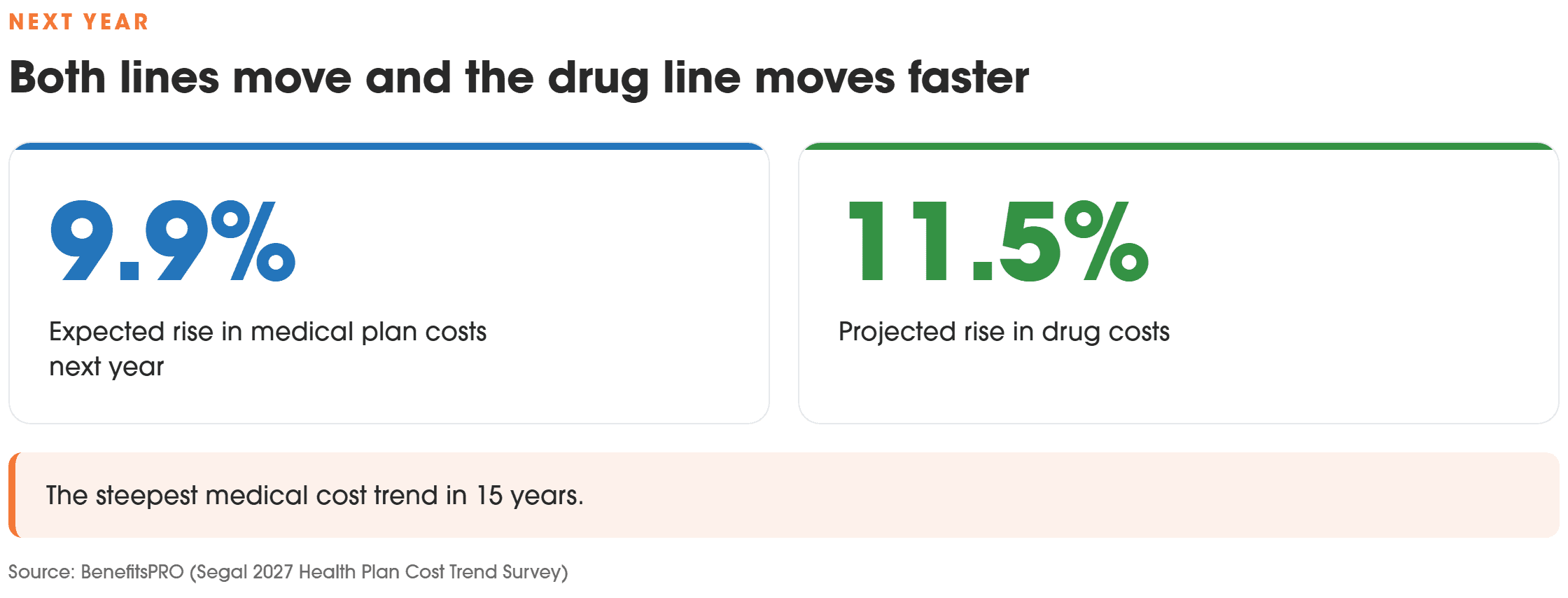
Three things are pushing those numbers, and none of them show up on your invoice.
Providers keep merging into bigger groups. Fewer and bigger providers means higher prices and more care used.
The same care is billed heavier. Hospitals are coding visits more intensively without patients getting more care. That is about 20% of the growth in hospital costs.
Disputed bills go the provider's way. The No Surprises Act protects patients from surprise out-of-network bills. When a bill goes to arbitration, providers win 88% of the time. Those disputes have added an estimated 5 billion dollars in costs since 2022.
You cannot negotiate any of that away on your own. What you can do is decide earlier, and decide with better information.
That is what employers are doing. They are narrowing networks, contracting directly, and steering care toward preferred providers. They are moving pharmacy away from rebate deals toward plain pass-through pricing. And they are moving procedures out of the most expensive buildings.
Every one of those choices gets made during the year. None of them can be made in the four weeks before you sign.
The thread running through all of it
Read all of that together and the same answer shows up each time. Not a clever product. Oversight, honest assumptions, and smaller decisions made earlier.
That is the gap between a plan that is managed and one that is simply renewed.
Renewing is a signature in one month of the year. Managing is somebody looking at the plan in March, and again in July. Then the renewal lands and you already know what you will do.
None of that requires being a large employer. It requires someone paying attention for you, all year.
Where to start
Ask yourself four quick questions.
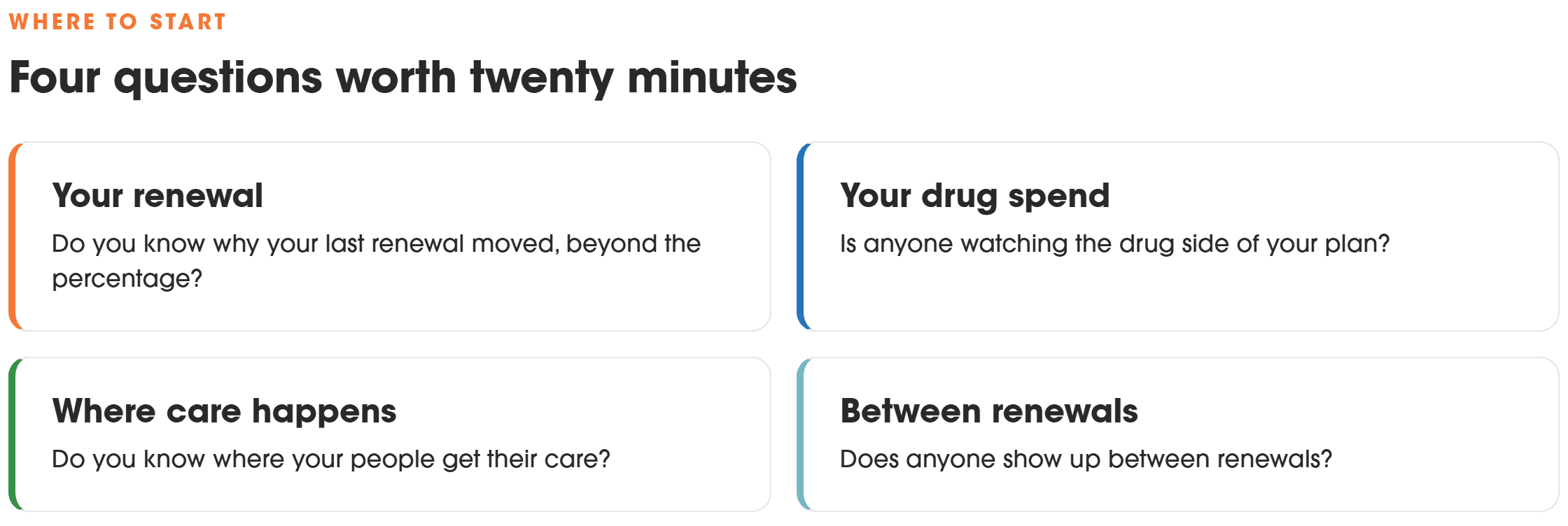
If you paused on two of those, that is worth twenty minutes of your time.
Sources: BenefitsPRO, "Soaring medical costs force employers to tighten benefits," reporting the Gallagher Benefits Benchmarks report. BenefitsPRO, "Health plan cost trend expected to reach 15-year high in 2027," reporting Segal's 2027 Health Plan Cost Trend Survey.


