

The year trimming stops working
Health plan cost trend is heading for its highest point in 15 years. Not a bad year. The steepest since 2012.
That matters less for what it does to one renewal and more for what it does to the habit most employers have built. Small yearly trims worked when the pressure was small and yearly. They do not work against a decade.

Five other reports from the past month explain why the usual moves are running out of room. Each one closes off a lever you might have reached for. Read together, they make the case for deciding early rather than reacting in November.
2027 is the steepest cost trend in 15 years
Segal's 2027 survey puts cost trend at a 15 year high. Trend is not your renewal. It is the pressure sitting behind your renewal, which means it shapes the next several years and not just the next twelve months.
For a company your size that changes four things.
One off fixes stop working, because you cannot trim your way through a decade. Timing matters more, because a decision made in November is a decision made under pressure. Your people feel it too, since their share rises alongside yours. And doing nothing becomes a decision of its own, with a price that compounds.
The employers who handle a year like this well are not the ones with a clever product. They are the ones who started the conversation in September.
Source: BenefitsPRO, "Health plan cost trend expected to reach 15-year high in 2027", Segal 2027 Health Plan Cost Trend Survey
When costs rise, most employers cut quietly
Gallagher's benchmarking work describes what actually happens when the number lands. Employers cut. A little less cover here. A little more deductible there. Nobody announces it. Everybody notices.
There are four moves and they are not equal. Each one buys you something now and charges you something later.
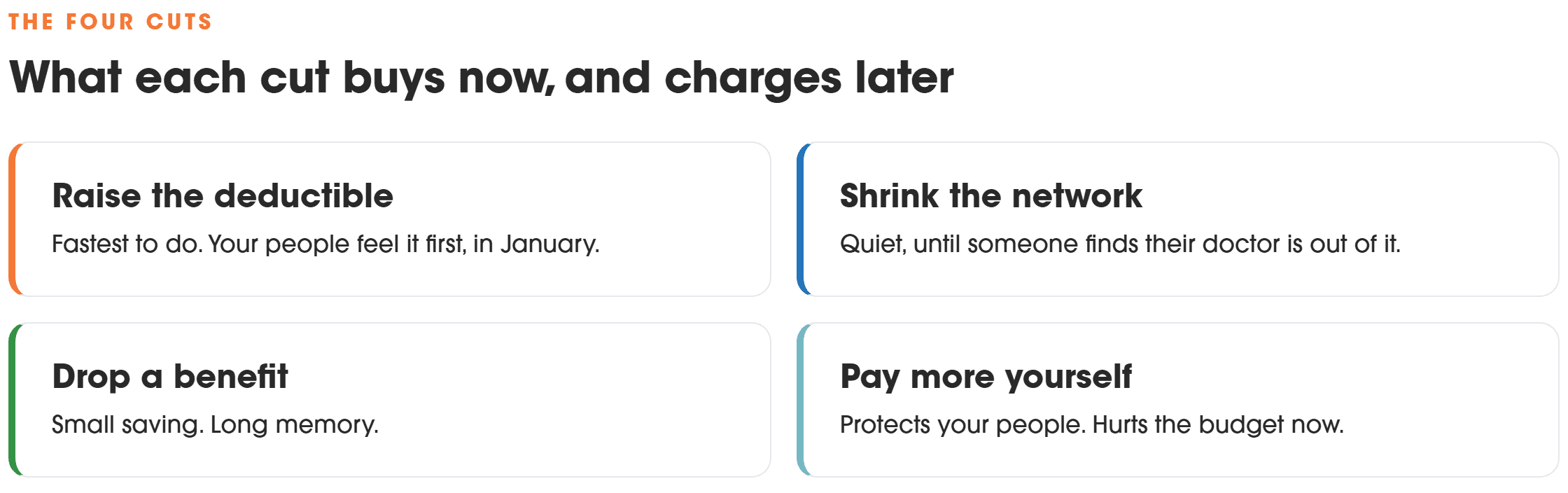
Most employers pick one and hope. The ones who come out of it best pick deliberately, then explain the choice to the people it lands on.
The cut is rarely the mistake. Making it without a plan, and without telling anyone, is what turns a reasonable decision into a story your team tells about you.
Source: BenefitsPRO, "Soaring medical costs force employers to tighten benefits", Gallagher Benefits Benchmarks
The high deductible trade, and who really pays it
Raising the deductible is the fastest of the four, so it is the most common. It is worth being clear about what it does.
The premium goes down. That part is real and it shows up in your budget immediately.
The cost of care does not go down. It moves. It moves to the person who gets sick.
A Health Savings Account is meant to catch that, and it does help. But the account only holds what has been put into it so far. In January it is nearly empty. So the deductible and the copays land in the first quarter, before the savings have had time to build.
That gap is the part nobody plans for. It is also the part that produces the phone call where an employee tells you they skipped a scan because of what it would cost.
Source: BenefitsPRO, "Supplemental benefits make consumer-driven health care work better", Commentary by Andrew Stocker
You cannot shop for a price you cannot see
The obvious answer to rising prices is to buy better. In 2021 hospitals were told to publish their prices so that patients could shop, employers could buy smarter and prices would settle.
Five years on, that has not happened at any scale, for four plain reasons.
Published is not the same as findable. The files are enormous and hard to use.
Findable is not the same as comparable. Every hospital lists things differently.
The penalties are small. Small enough to treat as a cost of doing business.
Regulators are only now pushing harder on real compliance. Five years in.
Try it yourself before your next renewal meeting. Pick one common thing, a scan or a knee or a birth. Give yourself ten minutes to find what two hospitals near you charge for it. Most people give up before they find a number they would trust.
That is your buying position, measured in ten minutes. The data exists and almost nobody can act on it, including you.
Source: BenefitsPRO, "Price transparency was supposed to change health care, but did it?", Hospital price transparency rule, in effect since 2021
Nobody uses the plan you already pay for
Before you change anything, there is a cheaper question. Is the plan you have now actually being used.
InComm Benefits surveyed more than 300 HR professionals for a report called The Spending Account Experience Gap. The finding that matters is what now decides which vendor a company picks. Not price. Not features. 73%, nearly three quarters, named employee feedback as a top factor.
In other words, whether people can actually use the thing.
Dave Etling of InComm Benefits put it plainly. "Employees are not necessarily disengaged from their benefits. Many are simply unsure how to use them. When employees need help understanding eligibility, claims, or reimbursement rules, HR often becomes the default support channel."
In a company of 40 there is usually no HR department for that to land on. It lands on you. Ten questions in a week, fifteen minutes each once you have looked the answer up, is two and a half hours. Over a year that is more than 15 working days of your own time, sitting on top of the premium you already paid.
You are not paying for a plan. You are paying for a plan plus yourself.
Source: BenefitsPRO, "HR frustrated by poor employee experience with HSA vendors", InComm Benefits, The Spending Account Experience Gap
Who actually touches your employees' health data
There is one more thing sitting behind the plan, and it does not appear on any renewal spreadsheet.
Your people think their health information goes to their doctor and their insurer. It goes considerably further. Navigation vendors who help them find care. Analytics companies who study the claims. Utilization management platforms who approve or deny treatment. Care coordination partners who follow up. Wellness companies running the programs you bought. Pharmacy benefit managers handling prescriptions. And now artificial intelligence firms sitting across most of the above.
A single breach at one such vendor, Xsolis, affected nearly 1.4 million people. Almost none of them had heard of the company. Most of their employers had not either.
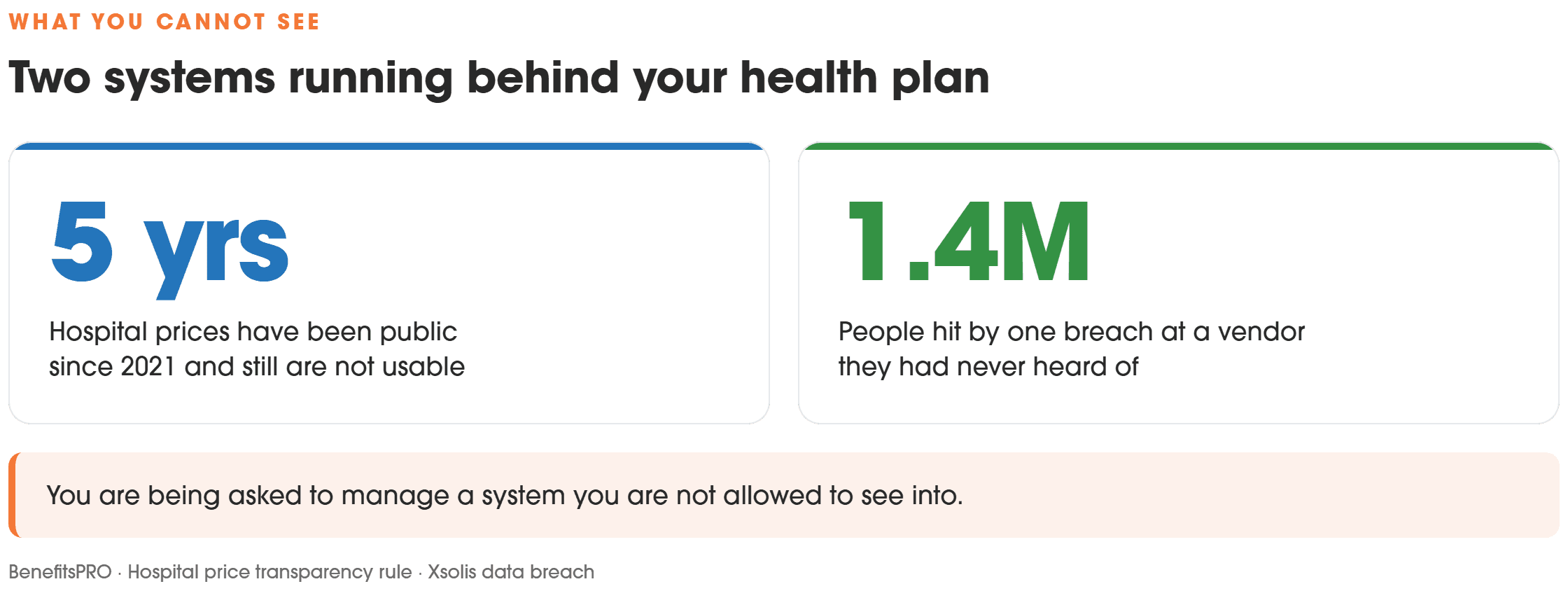
Both of these are the same problem wearing different clothes. You are being asked to manage a system you are not allowed to see into. Asking for the list of vendors behind your plan is a fair and ordinary request, and most owners have never seen it.
Source: BenefitsPRO, "Health care's new back door: AI vendors become the largest data risk", Xsolis data breach
Where to start
None of this argues for a particular product. It argues for a different rhythm.
Three things are worth doing before November, and none of them cost anything.
Write down every change you made at your last renewal, then write down who you told and how. Most owners can list the changes and not the telling. That gap is why people believe their benefits got worse for no reason.
Ask what your plan will roughly cost in 2028, not just next year. In a 15 year high year, a one year view is the thing that traps you.
Ask who your employees call when they cannot work out how to use the plan, and check that the honest answer is not you.
Benefits that only come up in November are being renewed, not managed. In a year like this one, that difference is the whole game.


