

Insured is not the same as ready
A health plan can be in place and paid for every month. It can still leave someone stuck when the bill arrives.
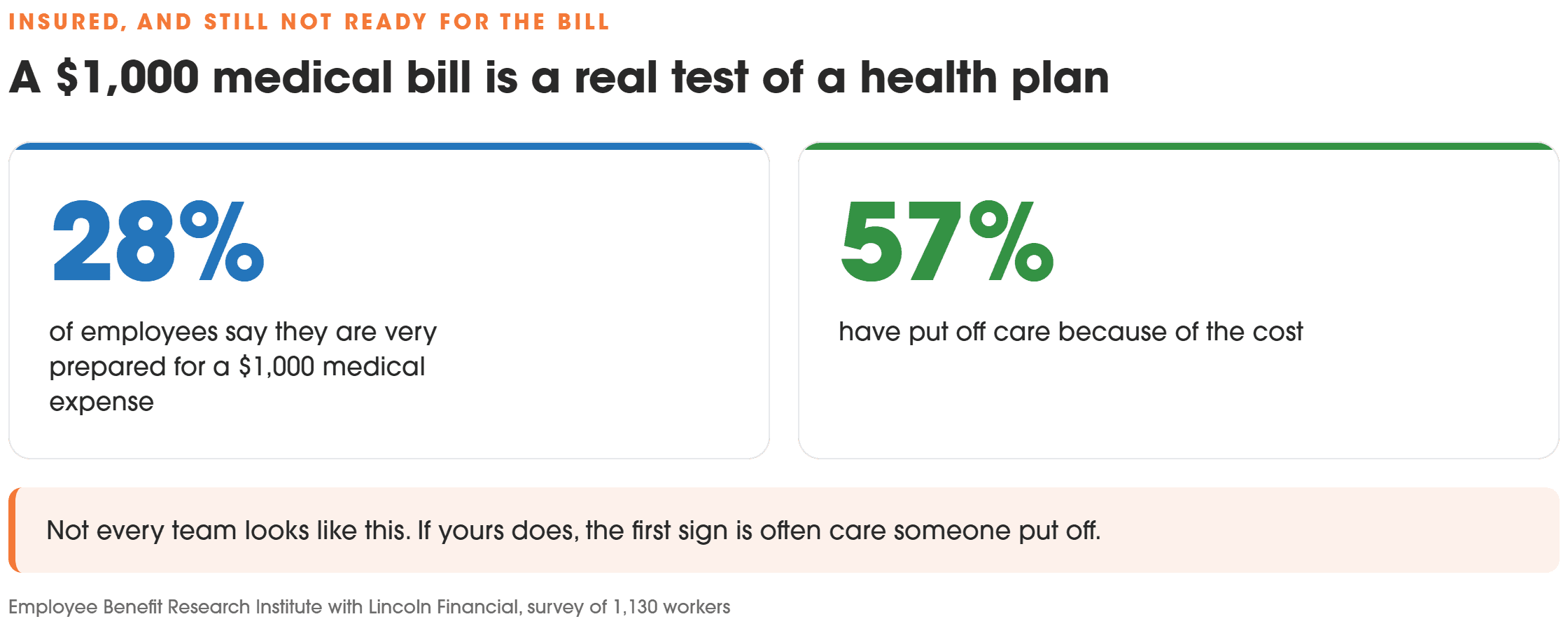
In a national survey of 1,130 benefits-eligible workers, only about 28% said they were very prepared for a $1,000 medical expense. Only about 21% felt very prepared for a $5,000 one.
Not every company looks like this. Some employers pay most or all of the cost, and their people rarely feel the pinch. But if your people are struggling to pay for care, the first sign is often care they put off.

The bill comes after the visit
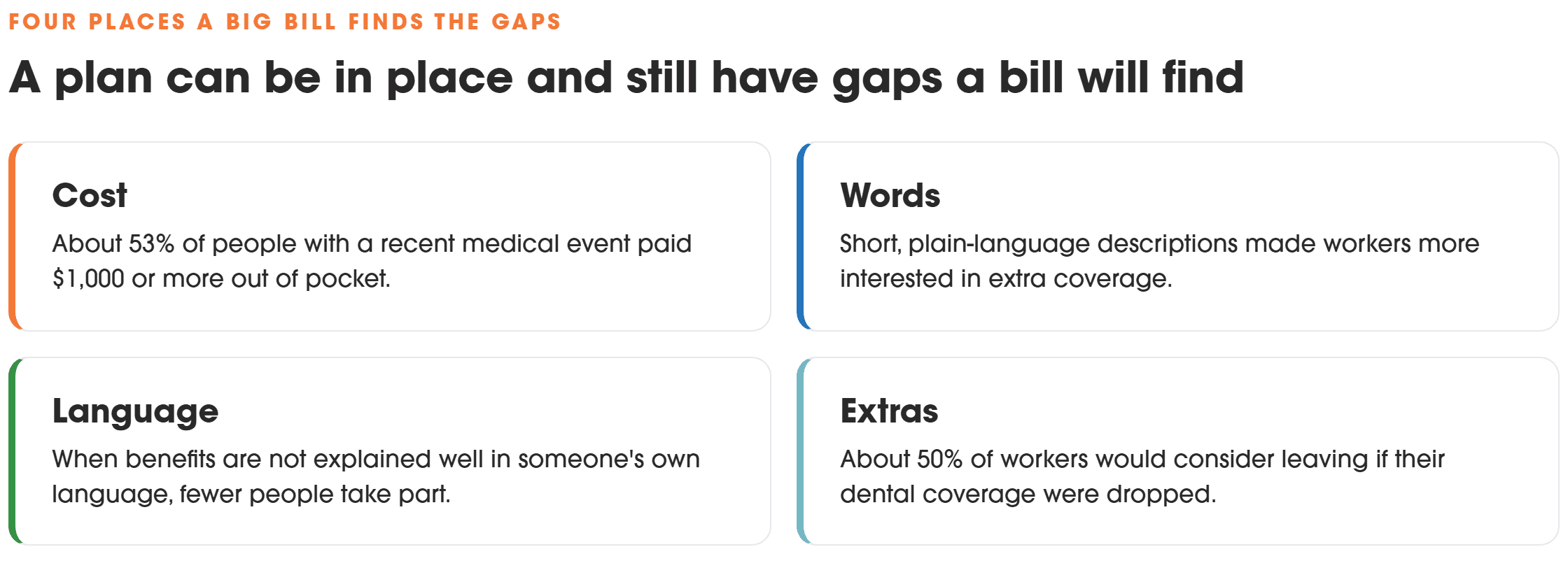
Medical costs are not rare events. About 28% of workers had three or more medical events costing more than $500 in five years. Among those with a recent event, about 53% paid at least $1,000 out of pocket.
Much of that money is not paid at the front desk. About 42% of workers usually paid after a bill arrived. About 27% set up payment plans. About 20% used credit cards.
For many people, the bill does not end there. About 47% reported at least moderate money trouble because of a medical event. About 37% had a medical bill sent to collections.
And about 57% have put off care because of the cost, 26% in the past year alone. The researchers point to other studies showing that delayed care can lead to higher treatment costs, more time off work and conditions that get worse.
Source: BenefitsPRO, "Insured workers struggle with unexpected medical bills: Study", Employee Benefit Research Institute with Lincoln Financial
Plain words change what people choose
One finding in that same research is easy to miss. When workers were shown short, plain-language descriptions of extra coverage, their interest in signing up rose noticeably.
Workers at companies with fewer than 500 people also reported less access to benefits information by email, websites, apps and social media. If your company has 20 to 99 people, that includes you.
So the plan itself is only half of it. The other half is whether people understood it when it mattered.
Frank Mengert makes the same point about enrollment. Employers spend weeks on guides, meetings, emails and reminders. The questions still come. What does this plan cover? How much will it cost me? Which option makes sense for my family?
His answer is not more material. People choose on the enrollment screen, not in the guide, so that is where plan details and costs need to be. As he puts it, more information is not always better communication. The goal is to make the information people already have easier to use.
Source: BenefitsPRO, "Open enrollment communication is a benefits tech conversation"
Information they cannot read does not help
If some of your people read another language best, there is one more gap to check.
Melissa Burkhart warns that treating translation as a button to press is risky. When benefits are not explained well in someone's own language, fewer people take part. Machine translation without a trained person checking it makes errors that range from a little misleading to insulting.
Her example sticks. "Health care," run through AI into Spanish, can come out as "Sanitary Support." Picture that on the page someone uses to choose a plan. AI can still help, as long as trained translators check the result.
Source: BenefitsPRO, "AI in multilingual benefits communication"
Given a place to set money aside, people use it
There is good news in the data too. When people have a way to save for health costs, most of them use it.
About 83% of employees with a Health Savings Account (HSA) put money into it in 2025, up from about 73% the year before. The average balance was $6,477. That is money that can go toward a doctor visit, a prescription or a bill nobody planned for.
An HSA only works with certain health plans, ones with a higher deductible. If your plan allows one, it is worth checking that your people know it is there.
Source: BenefitsPRO, "Employee HSA participation jumps to 83%: Report", Plan Sponsor Council of America, 2026 Health Savings Account Survey
The extras are not always extras
It can be tempting to see dental, vision, accident and critical illness coverage as extras. Workers see them differently.
In a Prudential survey of 760 employers and 3,096 full-time workers, about 66% of employees said their benefits showed that their employer cared about them. About 42% of those with critical illness coverage said their benefits met their needs, compared with about 34% of those without it.
About 80% said they would consider leaving if their employer dropped health coverage. About 50% said the same about dental.
The survey pointed to these benefits helping keep people even when employees pay for them. So before cutting one to save money, it is worth asking who uses it.
Source: BenefitsPRO, "Supplemental health benefits boost employee retention", Prudential Financial survey of 760 employers and 3,096 workers
Why the cost keeps moving anyway
All of this sits on top of rising costs. David Muhlestein and Elvira Makk Frid note that many employers saw health costs rise about 8% to 10% at their latest renewal.
What insurers pay doctors and hospitals is now public, and in theory that should help. In practice the raw files are enormous, formats differ and key details are missing. In one analysis by their team, over 90% of the listed prices were for services the provider never performs.
So health care is still usually reviewed once a year at renewal and adjusted a little. It is rarely managed with the same care as other big costs. You do not need to open those files. You need to ask the right questions before you sign.
Source: BenefitsPRO, "Leveraging pricing data at renewals"
What to do this month
You cannot see your team's medical bills, and you do not need to. A few simple questions will tell you a lot.
Ask your team, in an anonymous survey, whether they could cover a $1,000 medical bill without trouble.
Ask whether anyone has put off care because they did not know what it would cost.
Ask where they went to choose a plan and what they still had to ask someone.
If some of your people read another language best, ask whether the benefits information made sense to them.
If your plan allows a Health Savings Account (HSA), check that people know it is there.
Before you cut dental, vision or any other coverage, ask who uses it.
None of this needs claims data or a consultant. It needs honest questions and a plan for the answers.
Let’s Talk
See what it’s like to have the benefits department you don’t have to build.
A 20-minute Zoom. No pressure, no obligation.


