

Two decisions, one problem
Every year you make two big calls about your benefits plan. How it gets paid for. How it gets explained to your people.
Most employers make both of them on information that was never good enough for the job.
Not because anyone was careless. Because the easy number arrives on time, and the useful one does not.

Here is what that looks like in practice, and what to do instead.
Decision one: how your plan gets paid for
This is one of the biggest financial calls you make all year. It shapes your cash flow. It shapes how much risk you carry. It shapes how much freedom you have to design the plan. And it decides how much you ever get to learn about what is driving your own costs.
There are three common ways to pay for a health plan. Here they are in plain words.
Fully insured. You pay a fixed premium. The insurance company carries the claims risk, and keeps most of the data about your own people.
Self-funded. You pay the claims as they come in. You buy stop-loss cover so one catastrophic claim cannot sink you. In return you see your own claims experience, and you get far more control over how the plan is built.
Level funded. This sits in the middle. You pay a steady amount each month. It bundles an expected claims account, the stop-loss premium and the administration. If claims come in under projection, you may get money back.
For a company your size, level funding is an easy story to like. You get much of the data and flexibility of self funding. The cash flow still behaves like a fully insured plan. If you have never carried claims risk before, it is a sensible on-ramp.
But the real question is not which one sounds safer. It is which one your own numbers support.
Headcount is the first filter. It is not the answer.
Group size is usually the first thing anyone checks, and there is a good reason for that. Insurers set minimum enrollment numbers. Stop-loss pricing improves as covered lives go up. So does how much your claims history can be trusted.
Size is a real filter. It is also an incomplete measure of risk.
Two companies can clear the same size threshold and carry completely different risk.
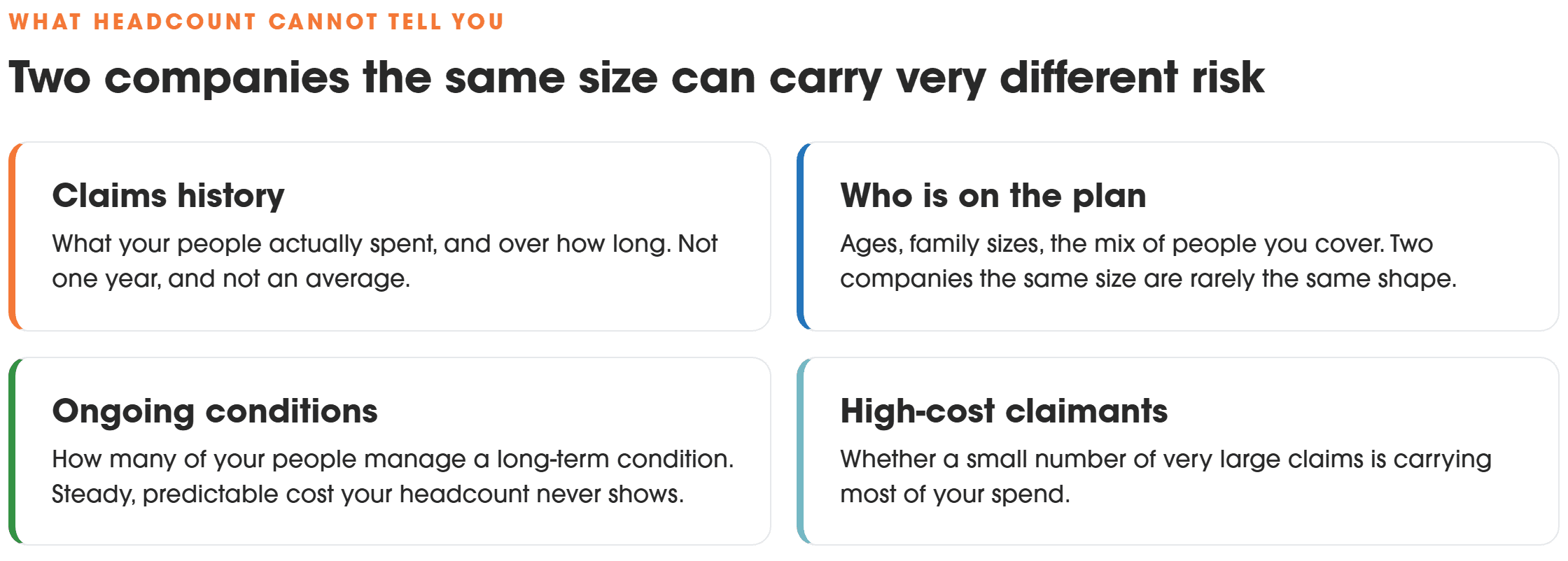
When nobody puts that deeper view in front of you, the decision defaults to caution. Or it defaults to whatever your current carrier proposes. That is a fair response to thin information. It can also leave real money and real control on the table.
It cuts both ways, and this is the part worth sitting with. A group that looks risky on paper can be a strong self-funding candidate. You just have to see what is driving its spend. A group that looks safe can be carrying concentrated risk. Level funding will eventually expose that at renewal.
Headcount cannot tell you which one you are.
Decision two: how your plan gets explained
Now the second call. Same problem, different shape.
Think about a classroom. When one student fails, you ask what happened to that student. When most of the class fails, you look at the system.
Benefits deserve the same test. When your people struggle to use their benefits, there is a usual explanation. They do not understand money well enough. Or they did not read what you sent. That answer asks them to come to you. It never asks whether the thing you sent was built for them.
Meanwhile the load on them keeps growing. Retirement moved from a promise the company kept to a decision the employee has to make. Health costs are doing the same thing, through higher premiums and higher out-of-pocket bills. Every year a little more of the risk, and a little more of the deciding, lands on one person.
And it lands on people who are already stretched. Housing, fuel and groceries cost more. Trust in big institutions is lower. Attention is shorter than it has ever been.
Then the benefits industry adds its own contribution. Separate systems that do not talk to each other. A carrier for this, a portal for that, a different login for the other thing. Nothing joins up.
That is the environment your people are asked to read a benefits guide in.
Employers think it is clear. Employees say it is not.
That gap is measurable, and it is wider than most employers expect.
In the United Kingdom, researchers asked employers about workplace pensions rather than health plans. Nine in ten were confident they explain the pension clearly. At least a third of their employees disagreed.
Different country, different benefit, same gap. It shows up here too. American employees are often so confused by their own health coverage that they struggle to use it.
One image from that piece is worth keeping. Its author once watched an actual rocket scientist appeal their own pension benefits. He has also seen a child translating benefits paperwork for a parent. Somewhere between those two sits every employee on your plan.
And here is the part nobody wants to hear. Benefits information tends to arrive at the wrong times. And in the formats people are least able to absorb.
Both decisions fail the same way
Put the two together and the pattern is identical.
On funding, you decide with headcount because headcount is easy to get. The claims picture that would answer it properly is harder to get. So it is missing when you need it.
On communication, benefits get explained in the industry's language, because that is the language the material shows up in. The version your employee could actually use takes work, so it never gets made.
Neither one is a failure of effort. Both are a failure of information.
Information problems do not get fixed in the four weeks before a renewal. They get fixed by somebody looking at your plan in March, and again in July. Then the renewal lands and you already know what you are going to do.
Where to start
Four questions. They take about a minute.
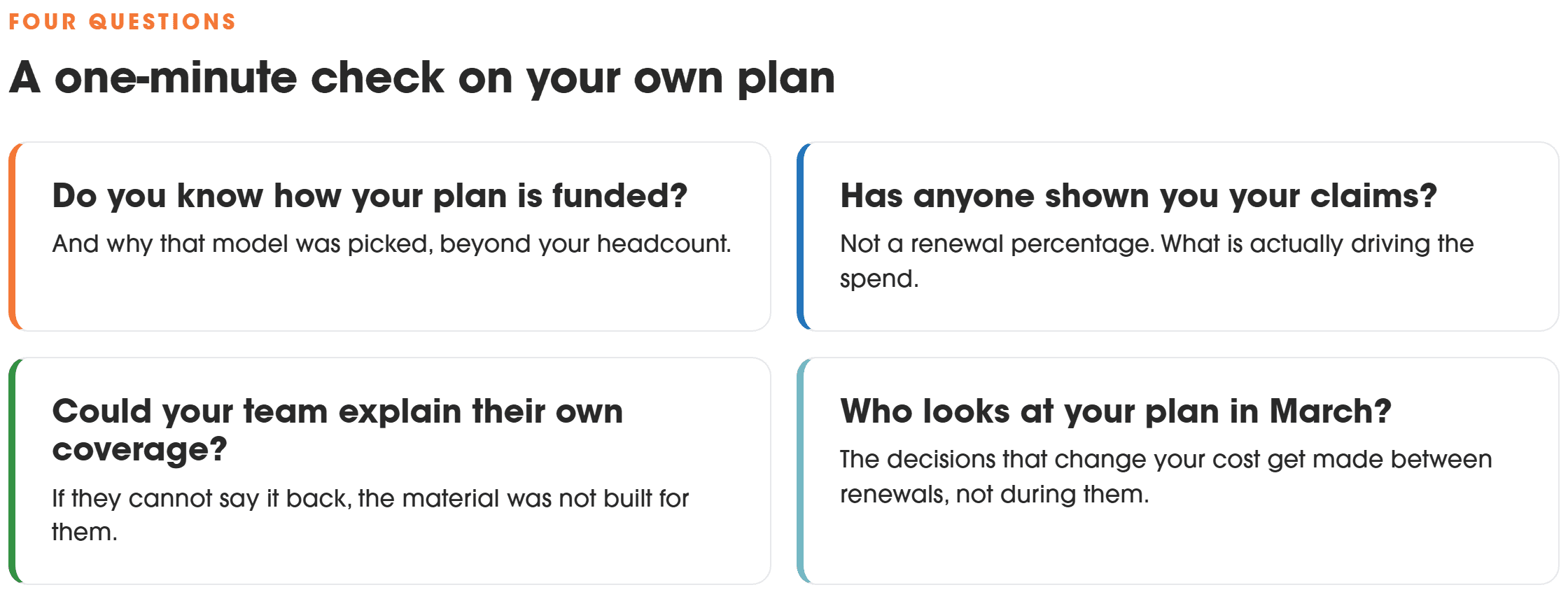
If you paused on two of them, that is worth twenty minutes of your time.
Sources: BenefitsPRO, "Level-funded vs. self-funded: Why data beats group size." BenefitsPRO, "Why failing benefits systems need a complete redesign."


